The short answer
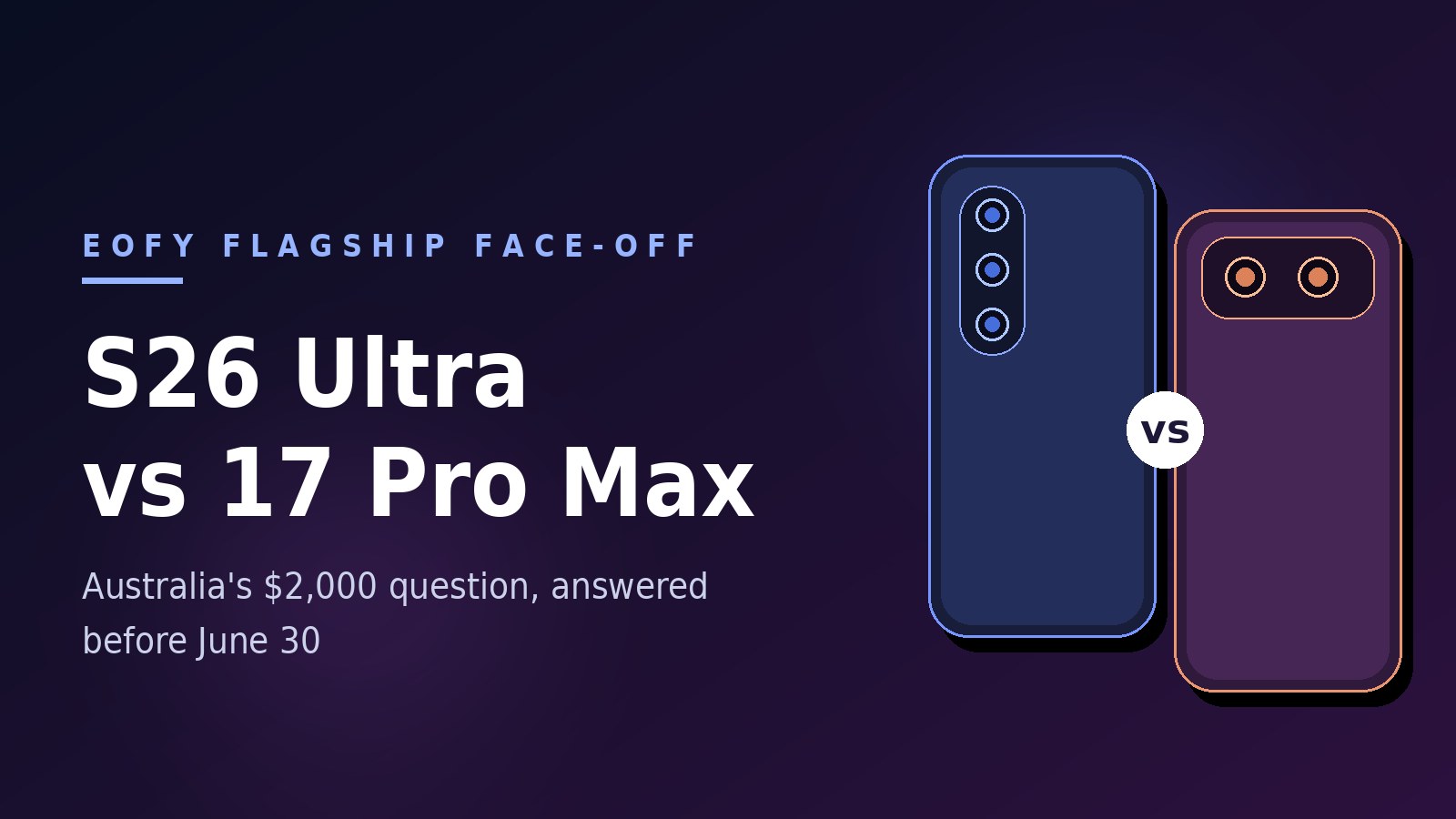
The Galaxy S26 Ultra is the better buy for most Australians this EOFY. Amazon has the 512GB AU model at $2,094 (verified June 11, 2026) — $405 under its $2,499 RRP — and at that price you get double the storage of the $2,049 iPhone 17 Pro Max for $45 more, plus the longest zoom reach of any phone sold in Australia.
Buy the iPhone instead if battery life decides your purchases, or if you live inside Apple’s ecosystem. Independent testing puts the 17 Pro Max among the longest-running phones ever measured, and a $150 discount on a current-generation iPhone is rarer than any Samsung sale. All prices in this piece are Australian dollars.
What EOFY pricing does to this matchup
At RRP, this is barely a contest worth having. Samsung asks $2,499 for the 512GB S26 Ultra and Apple asks $2,199 for the 256GB 17 Pro Max, and a $300 gap with half the storage on the Apple side reads like two different product classes. EOFY discounting collapses that gap to $45.
| S26 Ultra, 512GB | 17 Pro Max, 256GB | |
|---|---|---|
| Amazon AU price today | $2,094 (Black) | $2,049 (Deep Blue) |
| RRP | $2,499 | $2,199 |
| Discount | 16 percent | 7 percent |
| Owner rating (Amazon AU) | 4.1 from 19 ratings | 4.2 from 38 ratings |
Two catches in the fine print. The iPhone’s $2,049 price applied to the Deep Blue colour only when we checked — Cosmic Orange and Silver sat at $2,197. And Samsung’s 16 percent cut is EOFY promotional pricing, which Amazon’s own banners tie to the end of the financial year on June 30. Amazon AU is also running a trade-in promotion on the Samsung worth up to $800 in gift-card credit for a pre-loved device, which can pull the effective price well under $1,500 if you have a recent flagship to hand over.1
One more note for plan buyers: telco repayment contracts are typically built on RRP, not sale price, so a 36-month plan can quietly hand back everything the EOFY discount saved. If you can buy outright and bring your own SIM, June pricing is the argument for doing it. Sole traders eyeing the instant asset write-off before June 30 should ask their accountant whether a work phone qualifies — that decision is theirs, not ours.
Performance: the gap finally closes
For years the honest spec-sheet answer was that Apple’s silicon led on raw grunt and Samsung led on everything around it. The S26 Ultra ends that. Its Snapdragon 8 Elite Gen 5 is roughly 19 percent faster than last year’s chip, and benchmark testing shows its single-core performance finally catching Apple’s — the first Ultra where that sentence is true.2
One Australian wrinkle worth knowing: only the S26 Ultra gets the Snapdragon here. The standard S26 and S26+ sold in Australia run Samsung’s own Exynos 2600, so the Ultra is the model to buy if the processor matters to you.
The iPhone 17 Pro Max answers with the A19 Pro, and its story this year is less about peak speed than about keeping it. Apple moved the Pro phones to an aluminium unibody with a vapour chamber, and reviewers report sustained performance under long camera sessions and gaming loads that previous iPhones throttled out of.3 In day-to-day use, neither phone makes the other feel slow. Call performance a draw and decide on the other sections.
Cameras: reach versus consistency
Samsung’s pitch is hardware. The 200-megapixel main camera now sits behind an f/1.4 aperture — the widest ever fitted to an Ultra — letting in 47 percent more light than last year, and the 5x telephoto gets a brighter aperture too.2 The zoom stack still runs to 100x hybrid reach, and a Horizon Lock stabiliser keeps video level even if you spin the phone a full circle while recording. For wildlife, sport from the cheap seats, or school concerts shot from row Z, Samsung’s flagship has no peer on an Australian shelf.
Apple’s pitch is that every lens tells the same story. The 17 Pro Max carries three 48-megapixel cameras — wide, ultrawide and telephoto — so image quality holds up when you switch focal lengths instead of falling off a cliff past the main sensor.4 Reviewers consistently rate it the steadier video camera of the two, continuing a long iPhone tradition, and the new Center Stage front camera reframes group selfies automatically.
Owner reviews echo the split: Samsung buyers praise what the zoom can see, Apple buyers praise never thinking about which lens fired. Pick by how you actually shoot. If your camera roll is mostly people at arm’s length and video, the iPhone earns its keep; if it’s distance, low light and cropping freedom, the Samsung does.
Battery and charging: Apple’s quiet win
This is the section Samsung would rather you skim. The S26 Ultra carries the same 5,000mAh capacity as the past several Ultras, and testing describes its screen-on time as respectable but nothing special.2 Some owner reviews on the AU listing make the same complaint less politely. What Samsung does fix is refuelling: 60W wired charging takes the phone to 75 percent in about 30 minutes, with 25W Qi2.2 wireless on top.2
The 17 Pro Max goes the other way. Apple calls it the best battery life in any iPhone ever, and for once the marketing undersells it — independent lab testing recorded record-setting runtimes, and a one-month review measured seven to 10 hours of screen-on time under heavy use with maps, streaming and camera work.45 It charges slower than the Samsung, but it needs the charger less often.
If you are the person whose phone dies at 9pm, this section should outvote the camera one. Endurance is the 17 Pro Max’s single clearest advantage, and no Samsung software update will close it.
Software, AI and the privacy angle
Samsung ships the more adventurous software. Photo Assist edits images from a typed prompt, Creative Studio generates stickers and video effects, and the headline addition is a built-in Privacy Display that narrows the screen’s viewing angle on demand — whole screen, specific apps, or just incoming notifications and PINs — so the passenger next to you on the 96 tram reads nothing.6 No case, no stick-on filter, no resale-value-killing screen film.
The ecosystem question matters more than any single feature. A Galaxy Watch, Galaxy Buds and a Windows laptop make the Samsung the path of least resistance; an Apple Watch, AirPods and a Mac do the same for the iPhone. Cross-platform messaging is less painful than it used to be now that both sides support RCS, but accessories you already own should weigh on the decision, because replacing them costs real money.
Apple’s software story is quieter: fewer generative tricks, more polish, and the usual long support tail. Samsung commits to seven years of OS and security updates for the S26 Ultra; Apple publishes no number but has historically supported iPhones for six-plus years of iOS releases. Either phone outlives the typical ownership period. One caveat that applies to both: AI photo edits carry visible watermarks on the Samsung and metadata flags on the iPhone, so neither is a free pass for invisible retouching.
The cons column
Neither phone gets out clean, and the flaws are not the ones the launch keynotes mentioned.
The Samsung’s list: battery capacity unchanged for a fourth straight generation while rivals fit bigger cells; a 214-gram body that makes one-handed use a stretch; an Amazon AU owner rating of 4.1 dragged down by buyers comparing its endurance unfavourably with newer Chinese flagships; and EOFY pricing that snaps back toward $2,499 after June 30.
The Apple’s list: 256GB of storage at a price where Samsung hands you 512GB; a discount that applied to exactly one colour when we checked; wired charging that trails Samsung’s 60W refuel; and a zoom that tops out well short of the Samsung’s 100x hybrid reach. The 4.2 owner rating also comes from a phone line nine months into its cycle — a new iPhone generation typically lands in September, which matters if you resent buying near the end of a product year.
Verdict
The winner is the Galaxy S26 Ultra at $2,094. The EOFY discount turns a $300 premium into a $45 one, the 512GB of storage doubles what Apple offers at the money, and the zoom hardware does things the iPhone cannot. Buy it if you shoot at distance, want the bigger discount, or can feed the trade-in promotion a recent flagship.
The runner-up, the 17 Pro Max at $2,049, is the right call for two buyers: anyone whose day outlasts their battery, and anyone already paying for iCloud, wearing an Apple Watch, or messaging a blue-bubble family. Its endurance lead is real and measured, not marketed.
Skip both if your current flagship is under two years old — nothing here obsoletes an S24 Ultra or an iPhone 15 Pro Max — or if the budget stops at $1,500, where the standard iPhone 17 at $1,397 and grey-import S26 Ultra listings around $1,565 deliver most of this experience. On the imports, note the trade-off: no Australian warranty and no local AU firmware, which is a real cost hiding inside the saving.
Prices verified against Amazon Australia listings on June 11, 2026; check live listings before buying. All prices in Australian dollars.
Footnotes
-
Amazon Australia product listings for both phones, including EOFY savings and trade-in promotion, checked June 11, 2026. ↩
-
GSMArena, Samsung Galaxy S26 Ultra review: chipset, camera aperture and charging test data, 2026. gsmarena.com ↩ ↩2 ↩3 ↩4
-
CNN Underscored, “iPhone 17 Pro and iPhone 17 Pro Max: tested review,” 2025. cnn.com ↩
-
Notebookcheck, “Setting new battery life records — Apple iPhone 17 Pro Max smartphone review,” 2025. notebookcheck.net ↩ ↩2
-
Technetbook, “iPhone 17 Pro Max review after one month: A19 Pro performance, battery and camera,” October 2025. technetbooks.com ↩
-
PhoneArena, “Samsung Galaxy S26 Ultra review: private by design, familiar by default,” 2026; Samsung AU product documentation on Privacy Display. ↩